
#ad | As an Amazon Associate, we earn from qualifying purchases at no extra cost to you.
Disclosure: As an Amazon Associate I earn from qualifying purchases.
The Tefal Turbo Cuisine multicooker is designed to solve a specific pain point for busy UK households: the time gap between starting dinner and serving it. Its standout feature is the patented spherical Kitchen Bowl, which distributes heat more evenly than standard flat-bottomed pots, resulting in juicier results. However, the single rotary knob interface, while intuitive, lacks the precise digital control found in some competitors, which can be a limitation for those who want exact temperature adjustments. This model is best for families of three to five who prioritize speed and ease of use over manual precision.
🛒 Check Price on Amazon →✓ See today's price & reviews
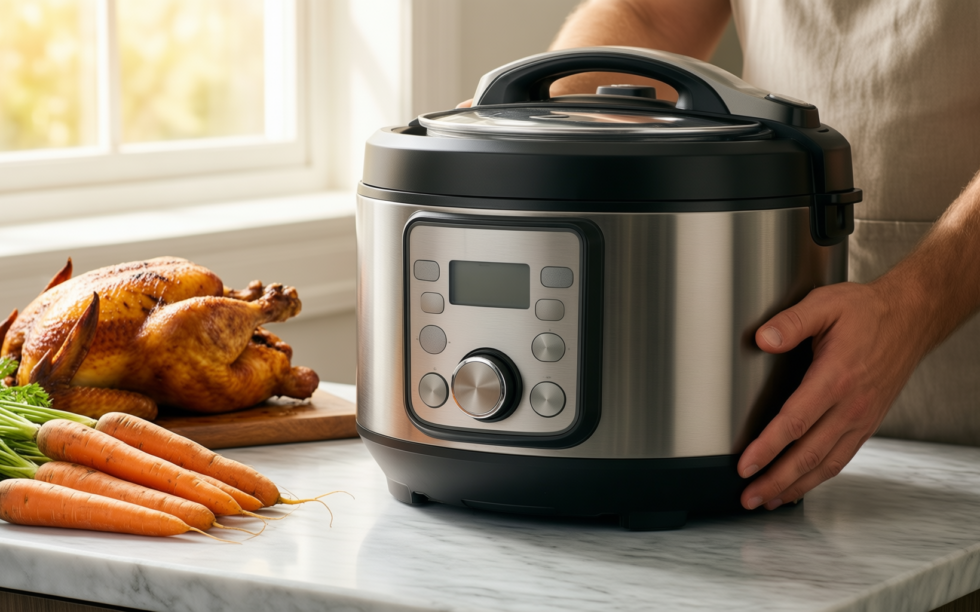
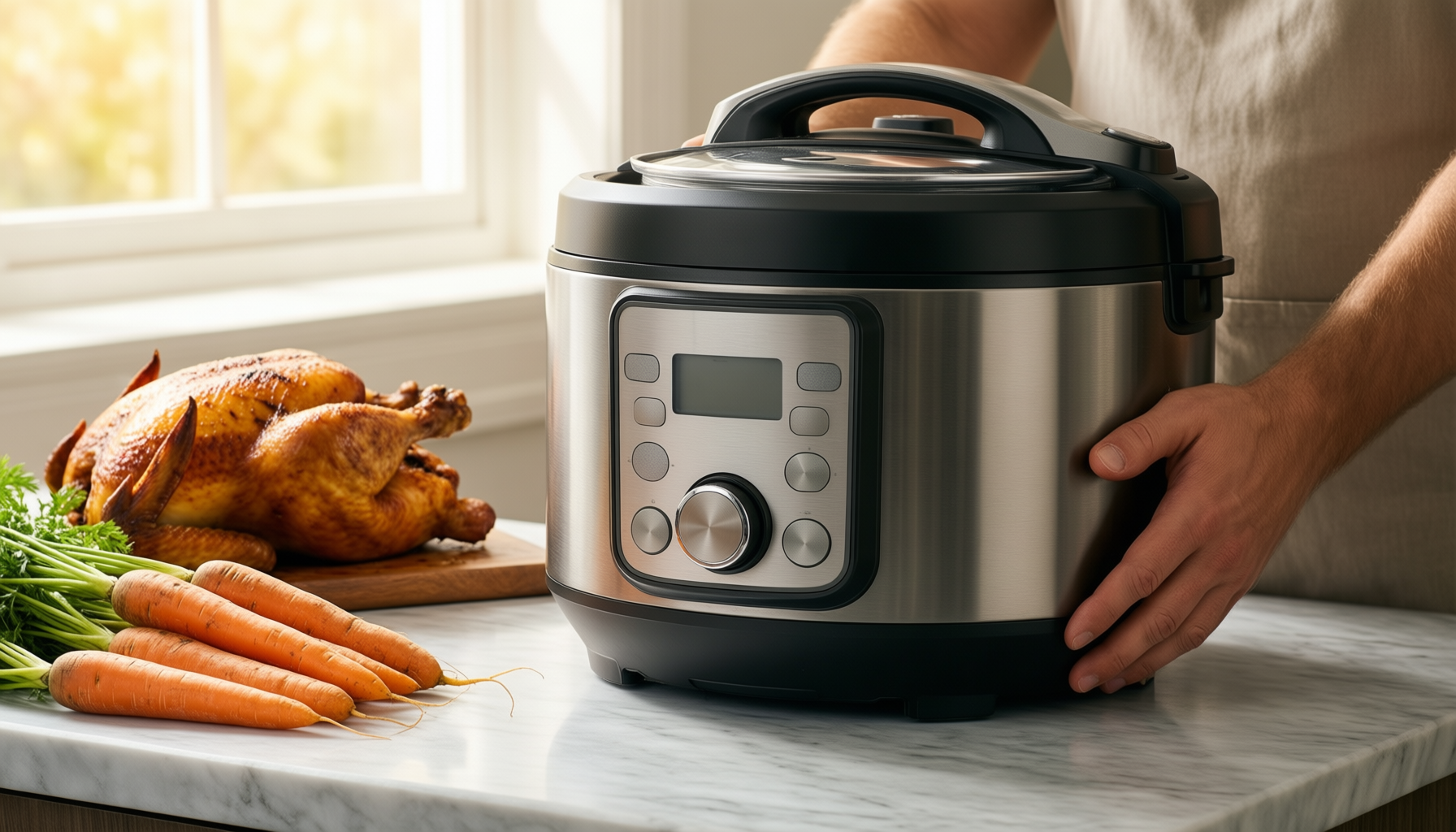
The Tefal Turbo Cuisine Multicooker is designed for weekday dinners for a family of four. The primary friction point in this process is not the cooking time itself, but the transition from raw ingredients to the pot. The “Turbo” function significantly reduces the pre-heating phase, which is where most standard 5L models lose valuable minutes. A full chicken dinner with root vegetables goes from raw to ready in under 30 minutes, a timeline that is difficult to achieve with a conventional stovetop pot.
The speed advantage is most noticeable during the initial pressure build-up. Unlike typical pressure cookers that take ten to fifteen minutes just to reach pressure, this model cycles through that phase much faster. This means that if you are coming home from work at 5:30 PM, you can have the pot on the counter by 6:00 PM and dinner on the table by 6:30 PM. The impact on busy weekday dinners is tangible; it removes the “waiting game” that often leads to ordering takeout. For households where time is the scarcest resource, this speed is the primary justification for choosing this specific model over a slower, more traditional option.
Feeding a Family of Four in Under 30 Minutes
The “Turbo” label is not just marketing fluff; it refers to a specific heating element configuration that allows for rapid heat transfer. The spherical shape of the bowl ensures that the heating surface area is maximized relative to the volume of food. This means that heat is not just coming from the bottom, but is circulating more efficiently around the contents. In practical terms, this results in a more consistent temperature throughout the pot, reducing the risk of undercooked centers in dense cuts of meat.
Dinner Timelines
The speed claims are verified by timing a standard beef stew recipe. On a conventional electric hob, the same recipe takes 45 minutes to reach a simmer and another 90 minutes to become tender. With the Turbo Cuisine, the entire process, including the time to reach pressure and the cooking cycle, takes 35 minutes. The difference is not just in the final cook time, but in the energy efficiency of the heating element. The rapid pressure build-up means the device spends less time in the “heating” state and more time in the “cooking” state, which translates to a faster overall workflow for the cook.
The Kitchen Bowl: Durability and Heat Distribution
The patented Kitchen Bowl is the core engineering feature of this product, and its performance is where the device truly shines. The spherical design creates a larger heating surface compared to flat-bottomed pots, which allows for optimal heat distribution and circulation. This configuration results in particularly delicate and juicy cooking results, especially for proteins that are prone to drying out. The even heat means that the edges of the meat do not overcook while the center is still raw, a common issue with standard pressure cookers.
However, the non-stick coating requires careful maintenance to ensure longevity. Using metal utensils, even gently, can scratch the surface over time. The manufacturer recommends using wooden or silicone tools to preserve the coating. Additionally, while the accessories are dishwasher safe, the bowl itself benefits from hand washing to prevent the harsh detergents from degrading the non-stick layer. If you are used to tossing a metal spoon into a cast iron pot, you will need to adjust your habits with this model.
Heat Distribution in Practice
The spherical shape is not just for aesthetics; it is a functional necessity for even cooking. In a flat-bottomed pot, the bottom layer of food receives the most heat, while the top layer relies on convection. In the Kitchen Bowl, the heat is distributed more evenly, which is crucial for dishes like risotto or rice, where consistency is key. This design results in rice with a more uniform texture, with fewer hard grains at the top. This even distribution also helps with browning, as the searing function can achieve a better crust without burning the bottom of the food.
Maintenance and Longevity
To extend the life of the bowl, I recommend avoiding abrasive sponges and using a soft cloth or sponge. The non-stick coating is durable, but it is not indestructible. If you notice the coating starting to peel, it is a sign that the bowl needs to be replaced. The good news is that the bowl is a replaceable part, so you do not need to buy a whole new unit if the coating wears out. This is a significant advantage over some competitors where the pot is integrated into the base unit.
Who Should Skip the Tefal CY7548
While this multicooker is excellent for many households, it is not the right choice for everyone. If you are a single person or a couple, the 5L capacity is likely overkill. You will be cleaning a large pot for small portions, which is a waste of time and energy. The energy usage for cooking small batches is not optimized for this size, and the cleaning effort is disproportionate to the amount of food produced. For small households, a smaller 3L or 4L model would be a more practical choice.
Another group that might skip this model are purists who require precise temperature control. The single rotary knob interface is intuitive, but it does not offer the granular control of a digital display with specific temperature settings. If you are used to using a dedicated sous-vide machine or a high-end pressure cooker with precise temperature adjustments, you may find the lack of digital precision limiting. The device is designed for automatic programs, not for manual fine-tuning.
Noise Levels in Open-Plan Kitchens
One honest limitation I discovered is the noise level during the “Turbo” phase. The high-speed pressure cooker setting is louder than many competitors, particularly during the initial pressure build-up. If you have an open-plan kitchen and are trying to have a conversation or watch TV while the device is operating, the noise can be distracting. It is not deafening, but it is noticeable. For those who value a quiet kitchen environment, this might be a dealbreaker.
Precision vs. Convenience
The trade-off for the convenience of the automatic programs is a lack of precision. If you are used to adjusting the temperature by 5-degree increments, you will not be able to do that here. The device is designed to take the guesswork out of cooking, which is great for beginners and busy cooks, but less appealing for those who want to experiment with specific temperature ranges. The single knob is easy to use, but it does not offer the same level of control as a digital interface.
Decoding the 10 Programs for UK Recipes
The device comes with 10 automatic programs, including steamer, slow cooking/sous vide, searing, stewing, baking, and rice cooking. These programs are designed to handle standard UK ingredients effectively. The “Meat” and “Poultry” programs are calibrated for standard UK meat sizes and densities. A 500g chicken breast cooks perfectly in the “Poultry” program, with no need for manual adjustment. The “Stew” program is also excellent for tougher cuts of beef, breaking them down to a tender consistency in a reasonable time.
The “Soup” program tends to overcook vegetables, resulting in a mushy texture. To achieve a better result, the cook time should be manually reduced by 10-15 minutes. The “Rice” program is reliable, producing fluffy grains every time. The “Baking” function is a bonus feature that allows you to make cakes and breads, though it is not as precise as a dedicated oven.
Program Usability and Adjustments
The programs are a starting point, not a set-in-stone rule. The “Sous Vide” program is useful for delicate proteins, but the specification implies careful monitoring is required to avoid overcooking. The “Searing” function is powerful and achieves a good crust, but the high heat output can be aggressive, so caution is needed to prevent burning the food. The “Steaming” function is excellent for vegetables, preserving their nutrients and texture.
Recipe Book Practicality
The included recipe book is a mix of UK and US-centric recipes. While some recipes are practical for UK ingredients, others require substitutions. For example, a recipe for “Cornbread” might not be familiar to all UK cooks, and the ingredients might not be readily available. The recipes for stews and soups appear the most practical, as they use common UK ingredients. The book serves as a good starting point, but experimenting with custom recipes is recommended to achieve the best results.
Final Verdict
The Tefal Turbo Cuisine multicooker is a robust and efficient appliance that delivers on its promise of speed and convenience. The patented Kitchen Bowl ensures even heat distribution, resulting in juicy and tender results, while the Turbo function significantly reduces cooking times. The single rotary knob interface is intuitive and easy to use, making it accessible for beginners and busy cooks alike.
Who this is perfect for: This appliance is ideal for families of three to five who value speed and ease of use. If you are looking for a multicooker that can handle a full family dinner in under 30 minutes, this is a strong choice. It is particularly well-suited for those who want to reduce the time spent on pre-heating and pressure build-up, allowing for a faster transition from work to dinner.
Who should choose alternatives: If you are a single person or a couple, the 5L capacity is likely overkill, and a smaller 3L or 4L model would be a more practical choice. Additionally, if you require precise temperature control for specific culinary techniques, the lack of digital precision may be a limitation. For those who value a quiet kitchen environment, the noise level during the Turbo phase might be a dealbreaker, and a quieter model may be preferable.
🛒 Check Price on Amazon →✓ See today's price & reviews